

Not Every Lump Is Just a Lump: When to Consider Specialist Treatment
Many people develop lumps and bumps beneath the skin throughout their lives. In most cases, these lumps and bumps are harmless (benign) and do not pose any risks to the patient. However, they can become uncomfortable, unsightly, infected, or cause concern because of changes in appearance. We always recommend regular skin checks with your Doctor to monitor and check all lumps and bumps, including benign moles.
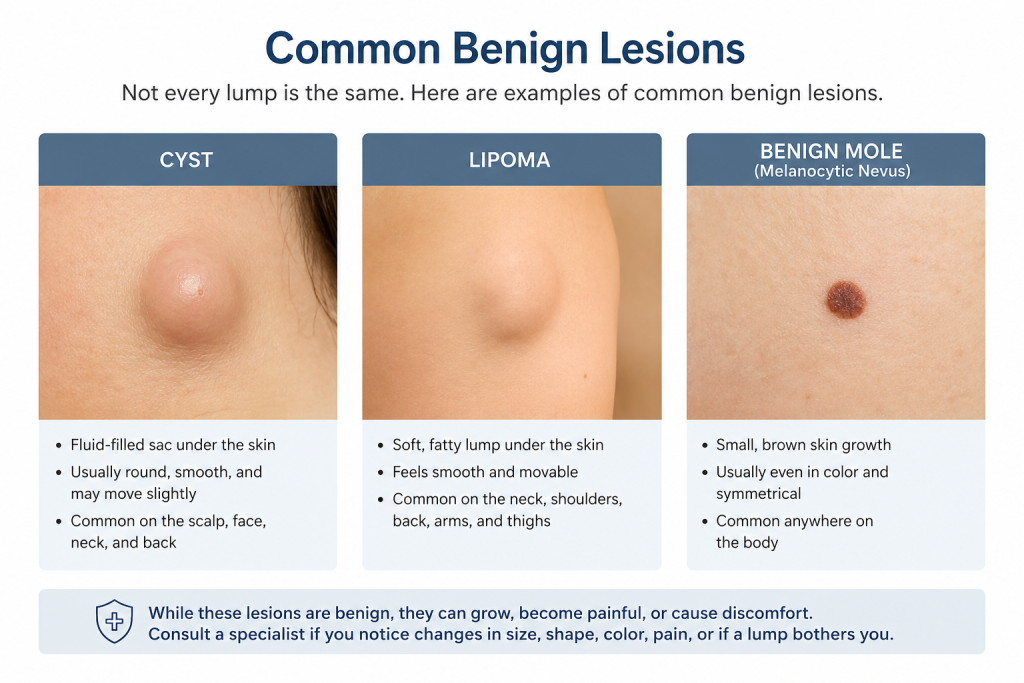
Some of the most common benign skin lesions include cysts, lipomas, and other soft tissue lumps.
What Are Cysts?
A cyst is a sac beneath the skin that contains fluid, keratin, or other material. They often appear as smooth, round lumps and can develop anywhere on the body.
While many cysts remain stable for years, they can sometimes:
- Become infected or inflamed
- Increase in size
- Rupture and/or become painful
- Cause cosmetic concerns for some patients, particularly if they are on the face or neck
Although some cysts can be drained temporarily, they invariably recur. Surgery and complete removal is the only way one can prevent recurrence.
What Are Lipomas?
We all have fat cells in our body and especially under our skin (subcutaneous tissue) that act as thermal insulation, a source of energy and for cushioning. Lipomas are benign overgrowth of these fats that coalesce into single or multiple soft lumps. Some people have just one while others have multiple. They can develop beneath the skin or even deeper tissues. They are usually painless and slow growing.
People often choose to have lipomas removed if they:
- Continue to grow
- Are uncomfortable
- Restrict movement or exercise
- Cause concerns about appearance
Larger lipomas or those located near important structures may require more specialised surgical management.
What is a Benign mole
Moles (also called Naevi) are aggregation of melanocytes which are the cells in the skin responsible for colour of the skin. They can be pigmented (various shade of brown) or skin coloured, but they are symmetrical in pigmentation and shape.
Moles are removed if they are
- They are suspicious and there is concern about them. This is when they become irregular in shape or in their pigmentation or start to grow rapidly.
- They are unsightly and for cosmetic reasons
- They are traumatised and cause discomfort.
When Should a Plastic Surgeon Remove These Lesions?
Not every lump requires a Specialist Plastic Surgeon. However, if getting the best cosmetic result is the aim, or the lump is in a difficult place, then a plastic surgeon is consulted.
For example, if:
- The lesion is located on the face, scalp, ears, eyelids, nose, lips, or neck
- The lump is large or has recurred after previous treatment
- The lesion is close to important nerves, blood vessels, or other delicate structures
- Reconstruction is needed following removal
The Benefits of Seeing a Specialist Plastic Surgeon
Specialist Plastic Surgeons are trained not only in the removal of lesions but also in achieving the best possible functional and cosmetic outcome.
Don’t Ignore New or Changing Lumps
While most lumps and bumps are benign, it is important to have any new, growing, painful, or changing lesion assessed by a doctor in the first instance. In some cases, what appears to be a harmless lump can represent a more serious issue requiring treatment.
If you have a cyst, lipoma, mole or other skin lesion that is causing concern, an assessment by a Specialist Plastic Surgeon, such as Dr Andre Safvat, can help determine the most appropriate treatment options and achieve the best possible outcome.
*This article is for general information and educational purposes only. It is not intended to substitute professional medical advice, diagnosis, or treatment. All surgery carries risk, and individual results may vary. Dr Andre Safvat, MBBS FRACS, Specialist Plastic Surgeon (MED0001155201), provides consultations at Ethique Plastic Surgery. A referral from your GP is required before consultation.